
Reconsidering Michael Bennett
Why the Director-Choreographer Left a Clouded Legacy

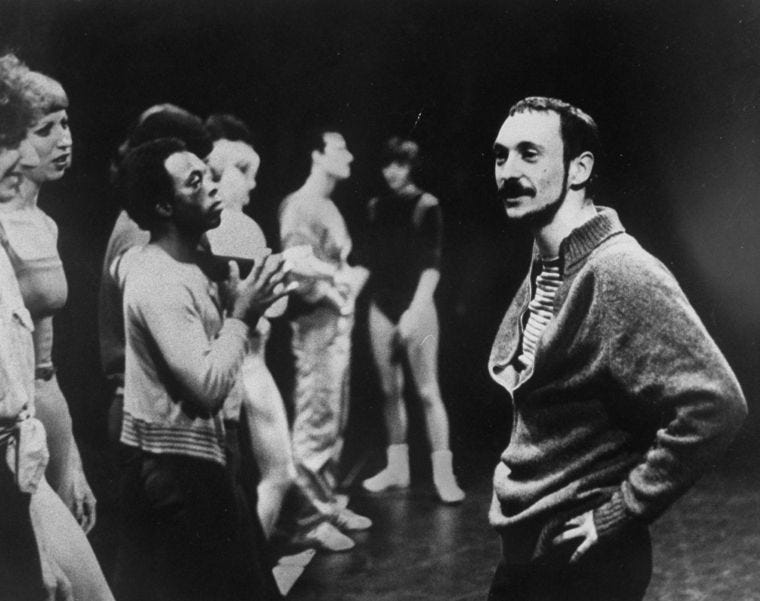
“My wife was hand-selected for A Chorus Line by Michael Bennett,” the man on my computer screen prefaced, before beginning the tale of his career as a young actor. He’s retired now, after a body of work that included long-running television shows and stints in musical theater. Over a ZOOM call we discuss his Broadway debut in Starlight Express. The project I was working on, detailing the history of that show, had brought me to the front steps of numerous former cast members. In talking to these people, who were at the apex of their careers in the 1980s, a decade as transformative for Broadway as it was destructive, Bennett’s name consistently surfaced in one manner or another. This was in spite of his never having had anything to do with Starlight, which opened four months before he died.
And it’s not without reason. Michael Bennett was born Michael DiFiglia in Buffalo, NY on April 8th, 1943. A skilled dancer from a young age, he dropped out of high school at age 17 to join Jerome Robbins in the international tour of West Side Story. Following a decade long career choreographing and “fixing” shows, Bennett reached superstardom with A Chorus Line. There can be no understatement as to how huge A Chorus Line was upon its premiere in 1975. By bringing together a group of dancers to discuss their lives, Bennett helped invent the musical workshop, a process now obligatory for any production trying to find its footing. The ticket revenue alone gave Broadway, which had been in decline for some time, a massive boost and renewed its cultural relevancy amongst the masses. As Michael Riedel writes in his book, Razzle Dazzle, “The ‘Fabulous Invalid,’ as Broadway was called whenever it looked to be in trouble, was getting out of her wheelchair.” The only show in recent memory that comes comparably close to these heights is Hamilton.
With the lucrative cashflow, Bennett would purchase a rundown building at 890 Broadway, a former garment factory, and convert it into an upstanding theatrical complex. There were rehearsal rooms, music studios, offices for costume designers and manufacturers. Creators could rent out space for workshops. Others used its facilities to rehearse. Much of the work on Ballroom and Dreamgirls, his two follow-ups to A Chorus Line, unfolded here. By the time the property sold in 1986, its alumni was estimated in the hundreds. Still use today, 890 is as close to a Broadway community as anywhere else in New York City.
Michael Bennett died of a lymphoma relating to AIDS on July 2nd, 1987. He was forty-four years old. Hearing of his accomplishments from books or even his Wikipedia page, I can’t help but feel a dissonance. The rhetoric is extremely formal, to the point. With other industry titans, one gets some vague impression of character. But no such vibrancy exists with Bennett. It is like hearing a friend explain to you the significance of an uncle who died before they were born, who only exists now in fuzzy photographs and second-hand stories. How could someone whose influence at one time could not be escaped, feel so distant now?
Reading Kevin Kelly’s biography of Bennett, One Singular Sensation, a few ideas arise. Bennett’s life was plagued by fits of depression, paranoia, and substance abuse; all of which he never received effective treatment for. These bled into his relationships like a glass of wine that’s been tipped over. Kelly characterizes Bennett as someone who struggled with emotional intimacy—even with those who could be considered close to him. As Donna McKechnie, a close collaborator who was briefly married to him in 1977, told Kelly: "The problem was his fear of closeness. It was very painful to witness someone you love unable to give back on a certain level, unable to have enough self-love to be able to take ... without suspicion.”
Being a workaholic with dance and theater as his only real interests, there was little to barrier between “Michael Bennett” from “Mickey DiFiglia”. Bennett problems contributed to how he behaved with those he worked with, often young dancers who were desperate for the chance to work with him. For many years, McKechnie was reluctant to discuss her marriage to Bennett, being estranged from him at the time of his death (her 2006 memoir alleges he attempted to sabotage her career following their divorce). Others under his tutelage recall a streak of “ruthlessness” and “cruelty”. Sheryl Lee Ralph, in her own autobiography, described rehearsals for Dreamgirls as a “dictatorship” in which Bennett played favorites, and attempted to drive a wedge between herself and co-star Jennifer Holliday. On one occasion, she says, Bennett’s temper reached its peak, and he struck her. Upon reporting the incident to Equity, she discovered it wasn’t the first time this had happened.
Drama surrounding the creation of A Chorus Line did not help Bennett retain cordial relationships with that show’s creative team either. Nicholas Dante, a dancer friend of Bennett who was a key player in the workshop sessions (Paul’s monologue was lifted directly from Dante’s own life), was soured by how little credit Bennett and the producers would give him. “I was a dancer just like Michael, and of course he made me fall in love with him, got what he wanted out of me, then basically threw me out like so much garbage, the way he did with everybody.” Dante would be embittered about Bennett until his own death in 1991.
Not all public talk of Bennett draws the same conclusions, however. Bob Avian, Bennett’s best friend and longtime collaborator, was vocally positive about their friendship; even dedicating much of his own autobiography to the topic. But in the same book, Avian maintained a strong focus on his own career as a choreographer—independent from his friend. On the other hand, Bennett’s surviving family have retreated into obscurity (his mother enjoyed limelight in the society pages for a few years before she passed away).
Then there is the matter of preservation of Bennett’s actual work. Recordings of his choreography and staging before A Chorus Line are far in few between (the surviving examples include a few awards show performances and an excerpts tape of the original cast of Follies). This leaves Dreamgirls and A Chorus Line, both filmed for the New York Public Library’s archives, as the only complete examples of Bennett’s prowess (even then his choreographic contributions to Dreamgirls were very minimal). It was only after A Chorus Line that the practice of recording shows for the Lincoln Center became a standard. Thus much of Bennett’s work prior to then can be considered “lost media.”
Compare all of this to one of Bennett’s contemporaries and rivals, Bob Fosse. The legendary director and choreographer died of a heart attack months after Bennett. Today, the Verdon Fosse Legacy, a non-profit led by daughter Nicole Fosse, has taken great strides to preserve the choreographer’s work. Through masterclasses and semi-regular performances, the Legacy has succeeded in keeping Fosse’s signature moves fresh in memory and accessible to contemporary dancers. No such equivalent has ever existed for Bennett. Nor have any of his collaborators or heirs stepped into the Nicole Fosse role as guardian of his creations. Baayork Lee, who originated Connie in A Chorus Line (also an accomplished choreographer in her own right) comes close. With the fiftieth anniversary celebrations in full swing, she has acted as a gatekeeper for the show itself, making numerous public appearances on its behalf. But in discussing Bennett, whom she clashed with during rehearsals, she speaks of him in a very surface level manner, dwelling more on what he accomplished than anything else.
Fosse’s foray in film, both in front of and behind the camera, also provide another venue of preservation. After the opening of A Chorus Line, Bennett was approached by Universal Pictures for a three-picture deal, with unlimited creative control. Nothing ever came of the agreement, with Bennett’s creative tendencies clashing with the studio system. While I wouldn’t make the claim that breaking into film is vital for any theater director to stake a legacy, one can only speculate how different Bennett’s legacy might have been had he fulfilled that contract.
Bennett’s difficulty in maintaining relationships evidently soured his collaborators’ ability to memorialize him in retrospect. None who knew him has—or is willing to—stand up to be gatekeeper of the man’s legacy. Combined with the poor preservation of his work, it’s no wonder that public consciousness holds a loose grip on Michael Bennett. I’ll leave off with Kelly’s observations on how Bennett’s personality intertwined with his work:
“If he had to be ruthless and cruel to shape Seesaw into something that wouldn't damage his developing reputation, he'd be ruthless and cruel. He'd do anything he'd have to. Maybe it was impossible to be successful and nice.”
Bibliography
•“Razzle Dazzle: The Battle For Broadway.” Riedel, Michael. Simon & Schuster. 2011.
•“One Singular Sensation: The Michael Bennett Story.” Kelly, Kevin. Doubleday Books. 1989.
•“Dancing Man.” Avian, Bob. University Press of Mississippi. 2020.
•“Redefining Diva: Life Lessons from the Original Dreamgirl.” Ralph, Sheryl Lee. Pocket Books. 2012
•“Time Steps: My Musical Comedy Life.” McKechnie, Donna. Simon & Schuster. 2006.
Love this, like always